How not to fix No Child Left Behind
 Lisa Fine/EdSource
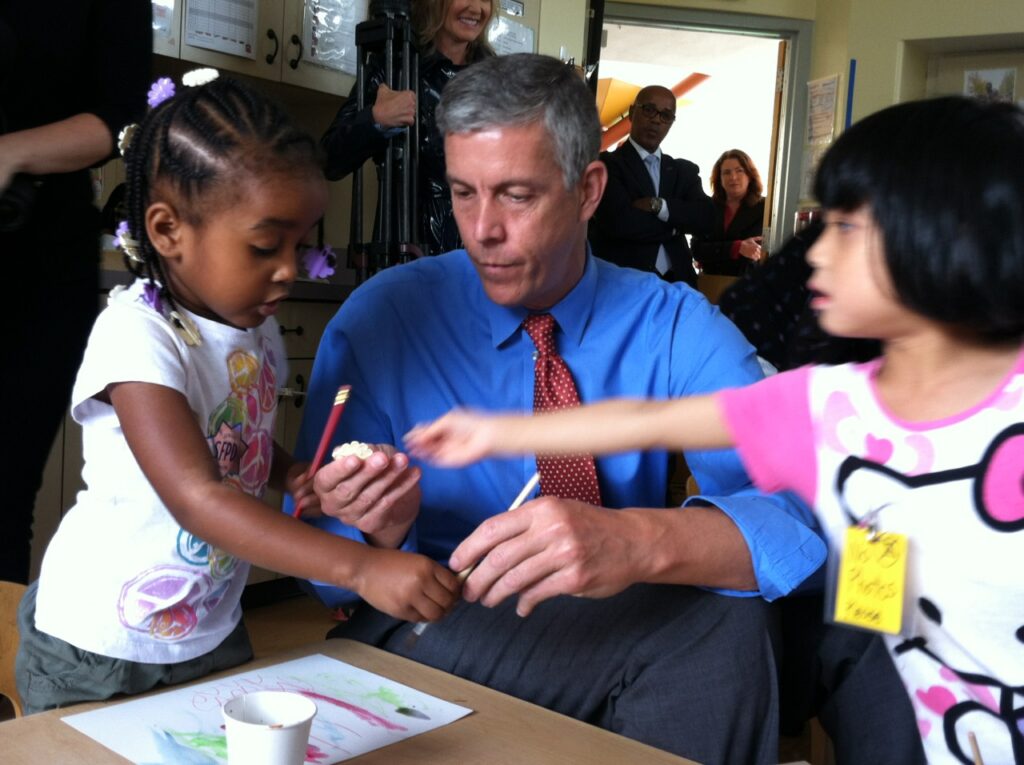
Didactics Secretary Arne Duncan visits a San Francisco preschool.
 Lisa Fine/EdSource
Education Secretary Arne Duncan visits a San Francisco preschool.
Mattilyn Gonzalez is a thriving student, who has earned straight A's and a spot in an accelerated learning program at her middle school. Her parents, Orlando and Celine Gonzalez, trace that success back to a strong preschool program – then they were adamant that their second daughter, Arianna, would get the aforementioned opportunities.
Just when Celine lost her job as a retail bank manager, the Gonzalez family could no longer afford the $720 per calendar month for Arianna to attend preschool. Fortunately, Arianna was able to attend, thanks to Los Angeles Universal Preschool (LAUP), a nonprofit supported past a federal early learning claiming grant to expand high-quality preschool opportunities. Today, Arianna reads ahead of course level, and recently earned the title "Star Student of the Month."
These are the kinds of opportunities every child in this country deserves – because quality preschool has been proven to help children get on a path to success, non simply in school, but in life. Unfortunately, efforts to expand preschool and other educational opportunities could exist at take a chance, amid a contend over renewing America's well-nigh of import education police force, the Elementary and Secondary Pedagogy Act (ESEA).
Expanding opportunity is a cadre priority for the Obama administration.
This week, President Obama released his budget, which includes the Preschool for All proposal, investing $75 billion over 10 years to provide high-quality preschool programs for all 4-twelvemonth-olds from low- and moderate-income families in every country. The upkeep also includes more than a $600 million increment for grants to encourage states to expand access to high-quality preschool.
And expanding opportunity is essential to our aims for a responsible reauthorization of the ESEA law.
ESEA stands as America's statement that a loftier-quality education for every single child is a national interest, and a ceremonious right. The law has boosted funding for schools in depression-income neighborhoods, put books in libraries, and helped ensure that minorities, students with disabilities, those learning English, those living in poverty, and others who take struggled would not sideslip through the cracks. While the attending NCLB brought to the needs of vulnerable student groups was valuable, its prescriptive and punitive interventions have left it reviled by educators.
Since then, and especially over the last 15 years, among a bipartisan agreement to focus strongly on students' learning, progress has been meaning. Since 2000, loftier schoolhouse graduation rates, once stagnant, rose about ten percent points, to an all-fourth dimension loftier. A young Hispanic person is now half equally likely to drop out of high school, and twice every bit likely to be in college. Just since 2008, at that place are a million more black and Hispanic students in college.
These are meaningful steps toward the day every unmarried child in this country – whether she woke upwardly in a homeless shelter or a migrant laborers' camp or a leafy suburb – has access to a solid teaching.
Yet Republicans in Congress have released a word draft of an ESEA bill that should worry anyone who believes that this entire nation has an involvement in the quality of children's education.
Few would question that No Kid Left Behind – the most contempo version of ESEA – needs to be replaced. While the attending NCLB brought to the needs of vulnerable pupil groups was valuable, its prescriptive and punitive interventions take left it reviled by educators. It's fourth dimension for a new law.
"Republicans in Congress accept released a give-and-take typhoon of an ESEA pecker that should worry anyone who believes that this entire nation has an interest in the quality of children's pedagogy."
Recently, I laid out cadre ideas for a new police force that ensures existent opportunity. A reauthorized constabulary must expand access to quality preschool and then that families all across the country like the Gonzalezes can exist assured that their children have every chance for a strong starting time in school and in life.
Early pedagogy is an area that enjoys widespread support from Republican and Autonomous leaders alike. Law enforcement officials, members of the clergy, military machine leaders, CEOs, parents, and educators almost universally agree that investing in early on babyhood education is a vital step toward securing the future success of our children and our nation. And the unmet demand for high-quality early learning is enormous. Here in Los Angeles County alone, at that place are more than than 33,000 four-yr olds who practise non accept whatsoever access to preschool.
A new constabulary also must aggrandize support and funding for schools and teachers. President Obama'southward upkeep will phone call for $ii.7 billion in new funding for ESEA, with offsets to ensure we don't go back to taxpayers for a dime.
It must aid to modernize teaching, through improved supports and preparation. And it must continue to enable parents, educators and communities to know what progress students are making – and ensure that where students are falling backside, and where schools neglect students yr subsequently twelvemonth, comeback will happen.
Knowing what progress students are making, in a useful way, ways states need an almanac statewide assessment. But nosotros must ensure that the tests – and test training – don't accept excessive fourth dimension away from classroom instruction. Corking teaching, not examination prep, is what engages students, and what leads to higher achievement.
There are a few questions we must ask ourselves as we decide the fate of this country's education law – and our children'due south educational opportunities.
Should nosotros practice more to ensure that all families have admission to quality preschool? The Republican plan says, "Information technology'south optional."
After years of progress, do we demand statewide indicators of what progress all students are making each year – as the nation'southward chief state school officers, and many civil rights organizations have asked? The Republican plan says, "It'southward optional."
Should funds intended for high-poverty schools actually get to those schools? The Republican programme says, "It'south optional."
Should this country support innovations by educators at the local level that improve education for our young people? The Republican programme says, "It'south optional."
We cannot afford to replace "the fierce urgency of at present" with the soft discrimination of "It'south optional."
I respect my Republican colleagues securely, and their intendance for this land's children is existent. So I am optimistic about reaching bipartisan agreement on a pecker that holds true to the promise of real opportunity.
In making choices for our children'due south futurity, nosotros will decide who we are as a nation. For the sake of our children, our communities, and our state, permit'southward make the right choice.
Arne Duncan is the U.S. Secretary of Didactics. Information about ESEA is available at ed.gov/esea .
To get more reports like this one, click hither to sign upward for EdSource'due south no-price daily email on latest developments in education.
Source: https://edsource.org/2015/republicans-on-wrong-track-on-education-law-reauthorization/74186

Post a Comment for "How not to fix No Child Left Behind"