Philly-made fruit-hacking tool fights food waste, saves farmers thousands
Concern for Good: The Fruit Hackers
Philly-based Strella Biotech aims to eliminate food waste material, a major factor in climate change—and save food distributors hundreds of thousands of dollars
Feb. 04, 2020


Like most people, you probably assume that in one case an apple tree is off the tree it's effectively dead, just a static object sitting on your countertop waiting to exist eaten.
 In fact, as Katherine Sizov understands, apples go along to be living entities, chock full of biological information.
Every bit founder and CEO of Strella Biotechnology, she has invented a device that reads that information to solve ane of the world'due south biggest bug: food waste.
Or, as she puts it, "We learned how to hack a fruit."
Strella's patented sensor sits in the cold storage room of produce packing houses, where information technology detects spikes in ethylene, the chemical that prompts the ripening process.
Using the Internet of Things (IoT), a organization that transfers data over a virtual network, the sensor alerts Strella, which then tells suppliers which apples should exist distributed first.
The client so has two months to get the produce onto grocery store shelves before it spoils—keeping it out of the landfill and saving farmers hundreds of thousands of dollars.
Sizov came upward with the idea in 2022 as a molecular biological science major at the University of Pennsylvania afterward realizing that the field she had committed to—neuroscience—wasn't actually her cup of tea.
"Office of the event with the enquiry I was doing was that I didn't actually see it helping people anytime in the near futurity," she says. "And I wanted to do something with my life that was actually going to help and contribute to society."
 She read academic papers, searching for a new area of involvement. That's when she came across the startling fact that 40 percent of the world'southward fresh produce is lost forth the supply chain, before information technology can fifty-fifty reach consumers.
"The grower loses some fruit because they don't have enough workers to help choice the fruit or maybe the quality is insufficient, so they merely leave it on the tree," Sizov says. "In packing, they have no idea where the ripest fruit is then they just move stuff and sometimes they open these storage rooms and a flood of moldy apples runs at them. On the retail front end, they have no idea which fruit is going to last for how long."
The effect, of course, is a massive loss in profits. But according to Dr. Shelie Miller, an associate professor at the Academy of Michigan's School for Surroundings and Sustainability, food waste material is also detrimental to the planet.
"If someone comes up to you and is similar, 'I can solve your biggest problem,' you're usually receptive to that blazon of discussion," Sizov says.
Her inquiry centers on a multifariousness of environmental issues, including nutrient waste product, and the emerging technologies dedicated to solving them.
"Fresh produce requires a lot of h2o, which requires a lot of energy to pump water to irrigate our crops," she says. "In that location are a lot of fertilizers and pesticides involved in agronomics, and overall a lot of energy in the process. And then anytime nosotros waste product food, we are increasing the environmental impacts of our food systems."
On pinnacle of that, when nutrient decomposes in landfills, it releases methane, a greenhouse gas that is at least 28 times more than potent than carbon dioxide.
If nutrient waste matter were a country, it would exist the third-largest emitter of greenhouse gases backside China and the U.S., according to the World Resources Institute.
As such, Project Drawdown, a coalition of experts focused on climate alter solutions, ranks reducing food waste material as the No. 3 activity item out of eighty to mitigating the crisis.
Struck by the enormity of this problem, Sizov realized no one was offering a viable solution—so she decided to find 1 herself.
Inspired by six years of working in medical labs, she wanted to create a piece of biotechnology that mirrors glucose tests, which diabetic patients utilise to monitor blood-sugar levels. Merely she had no idea how to build that.
"And so I went to a lab at Penn and went to the nicest professor I could discover and said, 'How would you lot go about doing this?'" Sizov says. "And then very, very slowly, nosotros congenital up something."
Zuyang Liu, a master'south student studying electrical engineering, as well contributed his expertise to assist construct the sensor.
One time they had a working product, they decided it would be best applied to apples, which sit in cold storage for over a year earlier they are purchased in the shop.
In October 2018, a packing house in Washington land agreed to test the product.
The post-obit January, the sensors detected an ethylene fasten in a storage room full of apples marked for distribution in July. When emitted, ethylene triggers the ripening process in surrounding fruit—the reason bananas, for example, brown faster when next to other bananas.
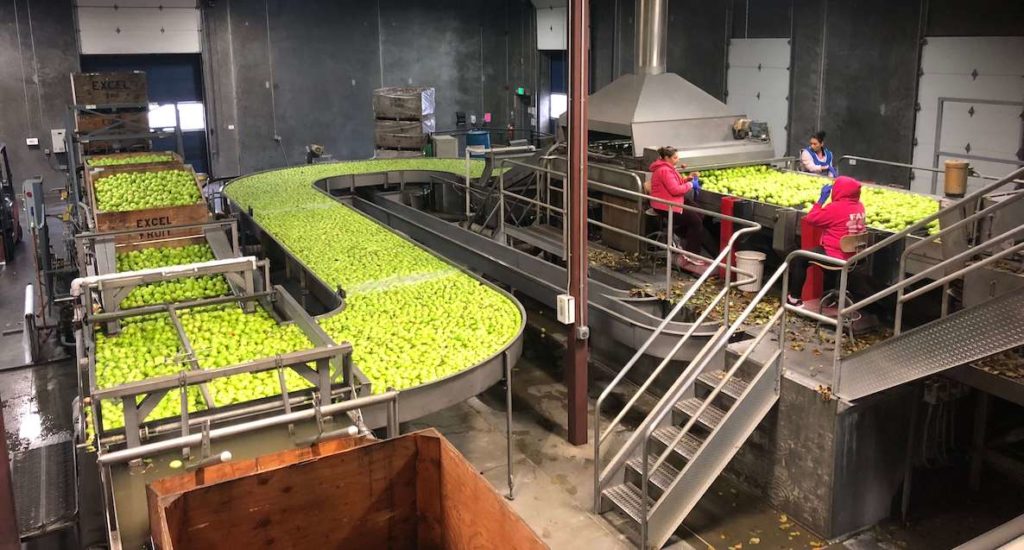
Knowing that the whole batch of apples would ripen and spoil long before the planned distribution appointment, Sizov told the customer to pull the apples immediately, saving the business organization $400,000.
With that success story under her chugalug, Sizov spent her senior year seeking funding, both on and off-campus.
She attended conferences, participated in innovation competitions and presented to investors.
 Her efforts earned the startup $550,000 in equity-gratuitous investment, from programs like the Academy of Pennsylvania'southward Penn Wharton Innovation Fund and President's Innovation Prize; the M&T Innovation Fund; the Summer Venture Awards; and the VIP-Xcelerate program.
Strella's client base has also grown. The visitor currently serves viii produce packers, which represent 21 percent of production for apples and pears in the United States.
And while Sizov says that, at 23 years erstwhile, her age tends to raise some eyebrows, almost of the farmers and packers she's approached are willing to listen to her pitch—peculiarly when they learn how much coin her tech could save them.
"If someone comes up to you and is like, 'I can solve your biggest problem,' you're usually receptive to that type of discussion," she says. "In general, information technology'south but recognizing that you lot are young and you don't know everything in the world. So you have to surround yourself with people who do know a lot more you in some aspects, and take all that advice and plow information technology into something."
The visitor, based out of incubator and co-working space Pennovation Works in Grays Ferry, is currently self-sustainable and supports a small staff of five.
Knowing that the whole batch of apples would ripen and spoil long before the distribution engagement, Sizov told the client to pull the apples immediately, saving the business organisation $400,000.
Lui now serves as vice president of engineering. Malika Shukurova, a bioengineer and longtime friend of Sizov's from Penn, serves as the head of research and evolution. And Jay Jordan, a sometime project manager at DuPont who met Sizov at a networking event at Cambridge Innovation Center, also works as the head of research and evolution.
"It'due south cool considering we all go along," Sizov says of her staff. "This is a collaborative effort because every single ane of u.s. knows something that the others don't. And so nosotros tap into that."
Strella has big plans for its next chapter. The company is hiring and is in talks with investors to raise at least $three million in the next few months. Merely the goal isn't maximizing profits, according to Jordan.
"If you have the opportunity to have a really large touch on, you really don't necessarily desire to go for profitability," she says. "You desire to invest as much equally you possibly tin can. So information technology's more like, 'How much can nosotros invest to move fast and solve this problem?' as opposed to, 'Are we profitable?'"
 The goal: move across cold storage and begin applying Strella's tech to every step of the supply concatenation, to monitor freshness during transportation and at the retail level.
According to Miller, addressing loss along the supply chain is crucial. Merely to truly eliminate food waste material, solutions should take a multi-pronged approach.
"I remember it's definitely a very promising technology," she says of Strella. "I think it is besides really important to highlight that food waste product at the household level is probably a bigger issue that [Strella] won't tackle."
But Sizov says that Strella does have its sights assault developing consumer-level tech in the future. The company has considered integrating its sensors into refrigerators, in order to alert people when food is expected to spoil.
For now, though, Strella's team is confident that maximizing the efficiency of distribution volition make a pregnant impact.
Sizov is enjoying the freedom that comes with entrepreneurship—besides as the knowledge that she'due south doing something worthwhile.
"I feel like when we were all children, anybody in course wanted to be the side by side president or wanted to be an astronaut," she says. "As people get older, they lose their hopes and dreams. I think running a business allows y'all to keep working towards those lofty ambitions and goals. And that keeps me passionate and excited most what I'm working on."
Want more nutrient-waste trouble-solving? Check out these related pieces:
- City community composting pilot is working to put food waste matter to good apply
- Rittenhouse nonprofit makes it easy for local restaurants to donate food waste product
- These rad vending machines gainsay food waste while promoting healthy eating
- Would a French law requiring groceries to donate surplus food work in Philly?

Source: https://thephiladelphiacitizen.org/strella-biotech/
Post a Comment for "Philly-made fruit-hacking tool fights food waste, saves farmers thousands"